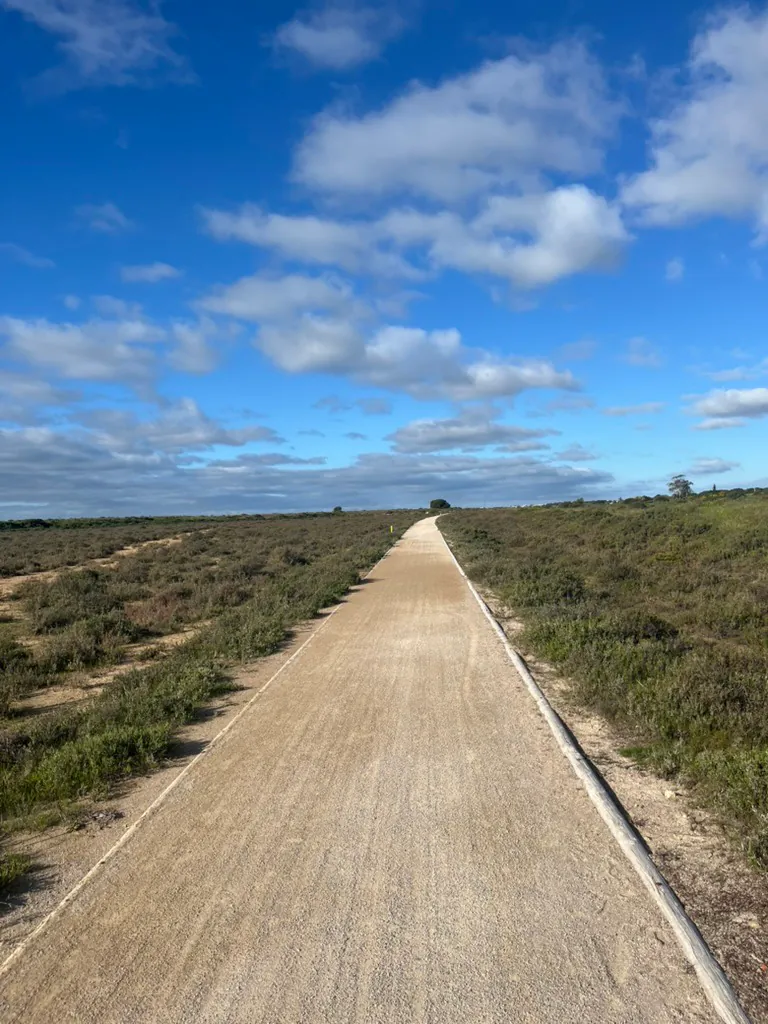
Fuseta has a reputation among kitesurfers that it does not have among anybody else. The reason is a branch of the Ria Formosa lagoon just outside the village: flat, shallow, sheltered water with a reliable thermal wind across it, which is close to the ideal beginner and freestyle setup and rare enough in Europe to draw people who have no other reason to visit an eastern Algarve fishing town.
If you are coming to work rather than to ride, two facts decide everything: when the wind arrives, and which months it arrives in. Both are inconvenient in ways the school websites don’t lead with.
The water
The spot sits in a branch of the Ria Formosa Natural Park, and the standard description of it is buttery flat water, knee to waist deep, with side-shore wind from the southwest at roughly 30 to 46 km/h (16–25 knots) on a working day [source: kitesurftheworld.com]. Shallow, standable and enclosed is exactly what you want when learning — you can stop, stand, and reset instead of being carried out.
That is the lagoon side. The Atlantic side, on the barrier island opposite, is ordinary open ocean with swell and no shelter, and it is a different sport in the same postcode. Beginners belong on the inside. So does anybody trying to squeeze a session in without a support boat and a spare afternoon.
The catch is the tide. The lagoon is mesotidal and roughly 90% of its area is intertidal — a range of about 1.3 metres on neaps and over 3 metres on springs [source: sciencedirect.com]. At low water, a large part of what you saw at midday is mudflat. Wind and tide have to line up, and only one of them is on the forecast page you’re already checking.
The season problem
Here is the part that reframes a winter stay. The spot is generally reckoned to work from mid-March to late October, and the thermal wind that makes it — the nortada — builds from around February through September, with June to August the prime months [source: kitesurftheworld.com].
The coliving season in Fuseta runs the other way. POMAR na praia is open October to April [source: pomar-coliving.com], which means a full winter stay overlaps the kite season by a few weeks at the very end and misses it entirely at the start. Arrive in January and the lagoon is beautiful, cold, and largely windless in the way that matters; the wind you do get is Atlantic frontal weather, which is gusty, directionally unhelpful and attached to rain. A thirteen-week stay across that season recorded gusts to 98 km/h (53 knots) in the worst week — that is not a kiting forecast, that is a reason to stay indoors.
So: if kitesurfing is the point of the trip, book the tail of the season and not the head of it. If the trip is about work and kiting is the upside, plan for the last month to be the only month.
Paddleboarding is the winter answer
Stand-up paddling inverts every constraint above. It wants the flat, windless water that ruins a kite session, which makes the calm winter mornings the best conditions of the year rather than the worst.
It is also the option with no logistics. Stand-up paddle equipment is part of the kit at the house [source: pomar-coliving.com], the lagoon is a short walk from the village, and a board goes out at first light and is back before a nine o’clock start. Local operators also rent boards and run guided lagoon and kayak tours if you want the channels explained rather than guessed [source: kite-algarve.com].
Tide still governs it. Paddling the lagoon around high water gives you the channels and the bird life — over 20,000 birds winter on this system, flamingos and spoonbills among them [source: lands.pt]. Paddling it near low water gives you a lot of walking.
Lessons and rental
Fuseta supports more of this than a village of about 2,000 people should [source: algarvetips.com]. The Kite & Foil Center Algarve is based in the village and covers kitesurf lessons and rental, hydrofoil, and SUP and kayak hire and tours [source: kite-algarve.com]; Kite Culture Algarve operates on the same lagoon. Instruction on the shallow inside water is standard IKO-certified beginner teaching.
Neither publishes a full price list in a form worth quoting, and lesson pricing in the Algarve moves with the season [verify: current lesson durations and prices at the Fuseta schools, and whether they open before mid-March]. Ask about opening months when you enquire, not just about availability — an operator can be reachable in February and not teaching until spring.
Fitting it around calls
This is the part that decides whether either sport happens at all, and it comes down to a scheduling collision.
The thermal typically fills in from early afternoon and peaks late in the day [source: kitesurfculture.com]. On UK or central European hours, that peak lands squarely on the last third of your working day — which is good news if you can finish at five and be on the water by half past, and useless if your afternoon is where your meetings live. On US-East hours, the arithmetic is worse: your mornings are free and the lagoon is glassy, and by the time the wind arrives you are starting work.
How much slack you have depends on your contract as much as your calendar. On a payroll, an afternoon that moves with the forecast means a conversation about core hours and a manager who understands that “the wind was good” is a scheduling input; freelance, it means protecting a two-hour afternoon block from clients who assume it is bookable, and eating the cost of the days it doesn’t blow. Same problem, different negotiation.
The workable version, for both: treat kiting as a weekend and end-of-day sport with a hard forecast dependency, and paddling as the weekday one. One of them fits around a job. The other one requires the job to fit around it, and is honest enough about that if you read the wind chart before you book.