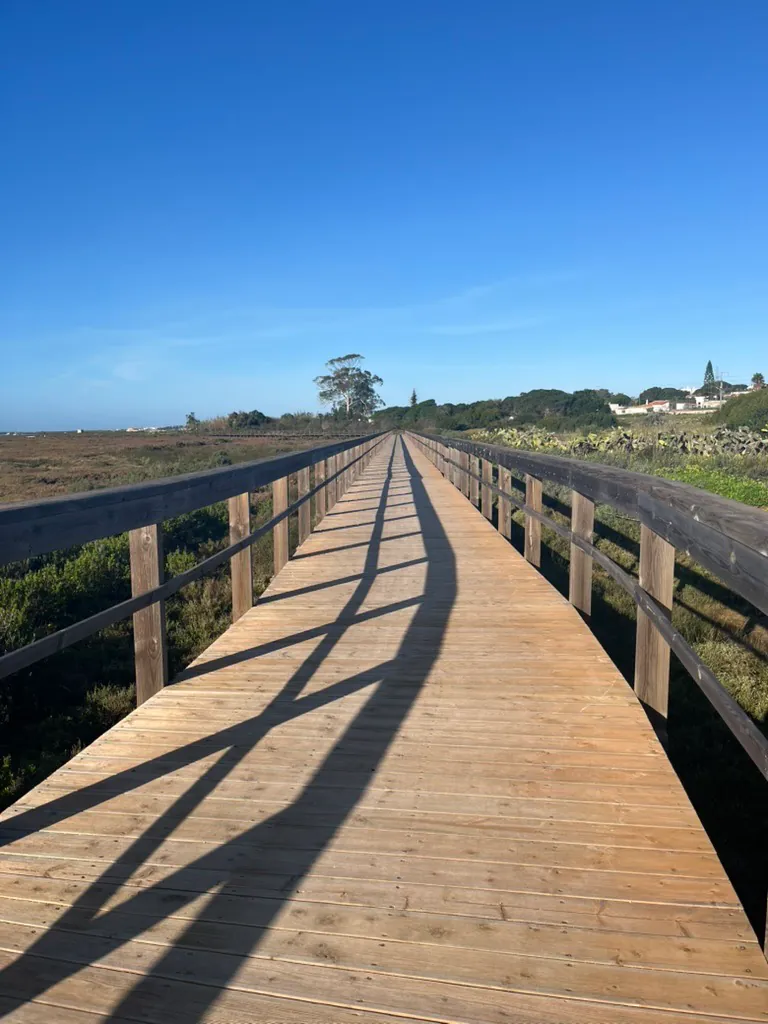
The Ecovia do Litoral is the Algarve’s coastal cycle route: 214 kilometres from Cabo de São Vicente in the far west to Vila Real de Santo António on the Spanish border [source: ecoviadolitoralalgarve.com]. Fuseta sits roughly two-thirds of the way along it, which means the route runs through the village rather than near it, and three usable sections start from the door.
What follows is compiled from route data and local operators rather than from a season of riding it — the winter stay this site’s Fuseta chapter comes from produced running, weights and a lot of rain, and no bike rides worth reporting. Treat it as a planning brief with the caveats attached.
What the Ecovia actually is, and isn’t
The first thing to correct is the mental image. This is not a continuous separated cycleway. The route runs mainly on secondary roads with limited traffic, linked by gravel and dirt sections, and the waymarking has largely failed: the blue route lines have mostly disappeared, with occasional painted bicycles and single-sided pole stickers where anything survives at all [source: ecoviadolitoralalgarve.com].
Practical consequence: bring a GPS track, and bring the right bike. Riders who have done it consistently recommend gravel or cyclocross tyres over a road setup, and the eastern sections through the wetlands are rough enough that a mountain bike is the safer default.
The compensation is where it goes. From Fuseta the route threads the Ria Formosa Natural Park — a lagoon system of salt pans, marsh channels and barrier islands that carries over 20,000 wintering birds, including flamingos and spoonbills on the pans [source: lands.pt]. Flat, quiet, and almost entirely unphotogenic in the way that means nobody else is there.
Ride one — west to Olhão and back
The obvious one. Olhão sits about ten kilometres west of Fuseta and the two towns are directly connected by the coastal Ecovia, running as a maintained gravel track along the wetland edge. Out and back is a little over twenty kilometres of essentially flat riding — comfortably an evening, and a genuine option for the Saturday market run if you have panniers and no interest in the train.
One thing to check before committing: the bridge on this section collapsed and stayed broken for a long stretch, and more recent reports have it repaired and fully passable [verify: current status of the repaired bridge on the Fuseta–Olhão section before riding it]. That is the kind of infrastructure claim worth confirming locally rather than trusting an article, this one included.
Ride two — east toward Luz de Tavira and Tavira
Tavira is about twelve kilometres east as the road goes, and the Ecovia section between the two runs via Santa Luzia through salt flats, quiet lanes and waterfront villages. The signposted Ecovia stage between Cabanas, just past Tavira, and Fuseta is listed at 22.1 kilometres, which brackets the Fuseta–Tavira leg neatly.
Ridden as an out-and-back it is at the top end of a two-hour evening. Ridden one way with the train home it is the best value on this list: the regional line stops at Fuseta-Moncarapacho and at Tavira, so you can push the outbound leg, eat in Tavira, and put the bike on a train back [verify: current CP bicycle carriage policy and any charge on the Faro–Vila Real regional service].
Ride three — the salt-pan loop inland
The third is less a destination than a shape: the tracks that leave the Ecovia just outside the village and loop north through the salinas and farmland before rejoining it. Route platforms carry a mapped Fuseta–Fontes Santas version of exactly this, and it is the one that stays rideable when the coastal sections are wet [source: alltrails.com].
It is also the honest answer to what a working day allows. An hour, no towns, no cafés, no reason to stop, back before dark — the ride you do on a Tuesday rather than the one you photograph.
Getting a bike
If you are staying at POMAR na praia, bike rental is included in the rate alongside laundry and housekeeping [source: pomar-coliving.com], which removes the question entirely and is worth more than it sounds in a village this size.
Otherwise, Fuseta itself is not a rental town — around 2,000 permanent residents [source: algarvetips.com] does not support a hire shop. The nearest reliable option is Tavira, where Abílio Bikes rents and runs a delivery and collection service across the stretch between Vila Real de Santo António and Olhão [source: visitportugal.com]. Several regional operators will also deliver to an address in Olhão or Fuseta. Book the delivery, not the collection — the logistics of getting yourself to a shop without a bike are exactly as circular as they sound.
The season is the real variable
These are all winter-viable rides in the sense that nothing closes. Whether they are winter-pleasant is a weather question, and the eastern Algarve’s cold half is not the still, sunny thing the region’s reputation implies.
Across a thirteen-week stay through that season, the wettest week rained on seven consecutive days, and the windiest produced gusts that would have put you in the reeds. On a flat, exposed, treeless lagoon track, wind is the limiting factor rather than rain — a headwind of that order turns a twenty-kilometre out-and-back into an hour of grim and an hour of free. The compensation arrives late: the closing weeks of the season ran completely dry, with light winds and long evenings, which is when these rides are worth planning around rather than squeezing in.
Who this is wrong for
Anyone on a road bike expecting a continuous surfaced route. The Ecovia is a long-distance touring line, not a cycle path, and the eastern sections are gravel with intermittent signage and occasional infrastructure failures.
It is also wrong for anyone treating “two hours” as a fitness constraint rather than a daylight one. In the middle of the winter season the sun is down by around half five in the afternoon [source: gaisma.com], and the salt-pan tracks have no lighting, no signage and no traffic to be seen by. Ride the flat empty ones early in the week, take the train home from the long one, and leave the exploratory detours for the end of the season when the evenings come back.