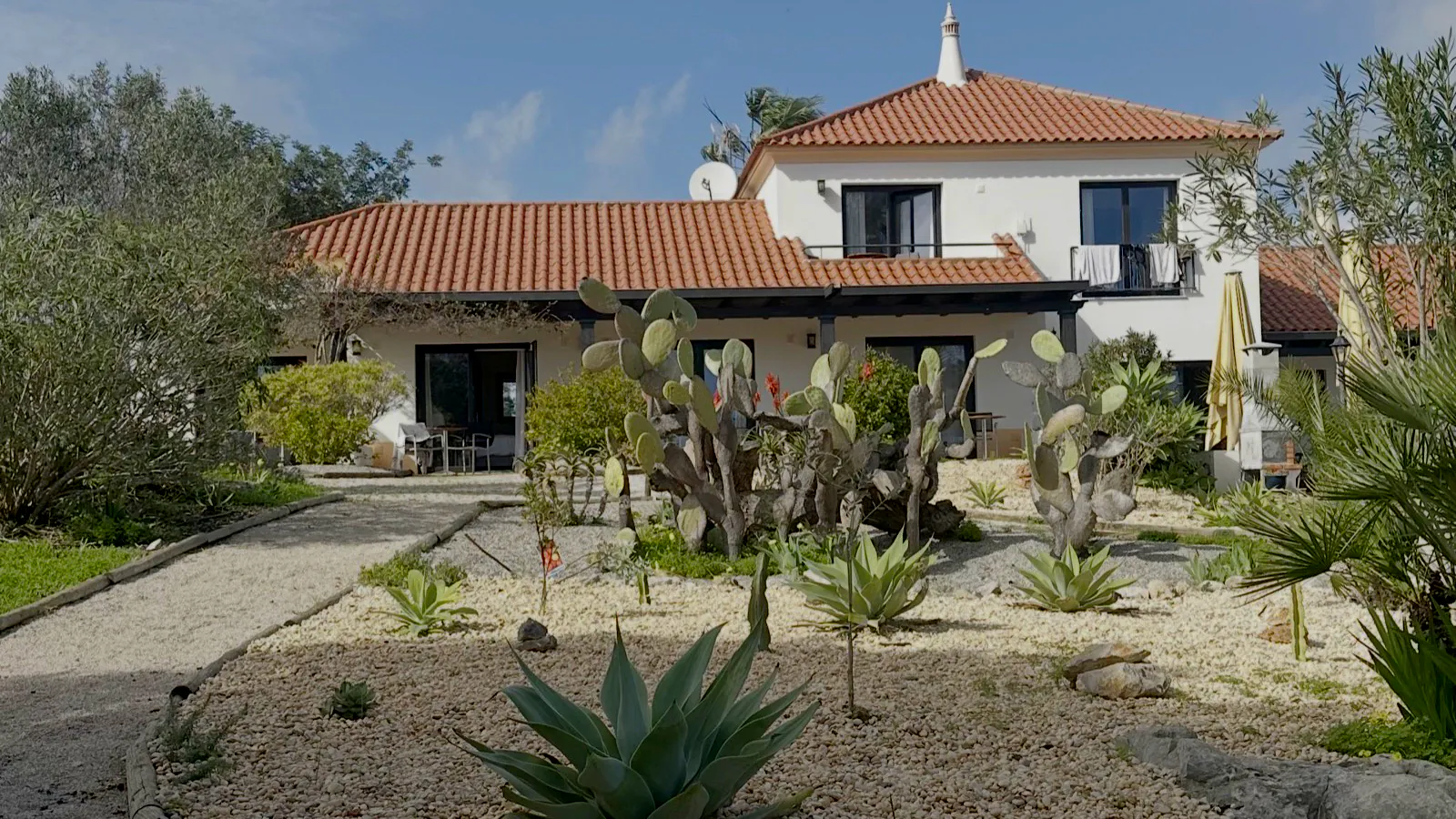
Almost every coliving in Europe sells you the good weather. The eastern Algarve houses do the opposite: they open in October, run through the wet half of the year, and close in April — precisely when the region starts being the thing the brochures are about.
POMAR na praia in Fuseta publishes exactly that season, October to April [source: pomar-coliving.com]. Its sister house inland runs year-round, which makes the contrast useful rather than accidental: one is a farm that works in any month, the other is a village house whose whole proposition is the months nobody else wants.
If you are choosing a destination rather than a building, this is the single most informative fact on the page. It tells you what the operator thinks their guest is doing here, and it is not sunbathing.
The economics are not subtle
In summer, a house within walking distance of a beach on this coast is a holiday rental. It commands holiday-rental prices from people staying seven to fourteen nights, who need no desk, no monitor and no community manager, and who will not complain about the price because they are on holiday.
A coliving cannot win that auction. It sells four-week blocks at a rate that has to look reasonable to somebody comparing it against their rent at home — the published four-week tiers for the coming season are €1,200 with a shared bathroom and €1,360 with a private one, with two-week tiers at €800 and €870 [source: pomar-coliving.com]. Those numbers are a bargain in February and an act of charity in August.
So the building changes job with the calendar. Through winter it is a workplace with beds. Through summer it is worth more as something else, or worth more shut. Either way, the guest it was built for has gone home.
What the region does in the meantime
The eastern Algarve is not a resort strip. Olhão has more than 45,000 residents and is the largest fishing port in the region, with no beach of its own [source: algarvetips.com]. Faro has over 60,000, an airport and a university, and is at its liveliest in autumn and winter because the students are back [source: algarvetips.com]. Fuseta has around 2,000 permanent residents and a working harbour [source: algarvetips.com].
None of that shuts down. What shuts down is the layer built for visitors — the beach concessions, the rental kit, the ferry to the barrier island, which runs only from March to October [source: algarvetips.com].
For somebody working five days a week, that trade is close to free. You lose the amenity you were going to use twice and keep the market, the train and the lunch places, at a quarter of the summer footfall.
The bill arrives as weather
This is where the honest version departs from the marketing one, so here are real figures from one thirteen-week stay in Fuseta.
The opening week was effectively dry — one damp morning that dried out by lunch. The second was wet on five days, with wind that made the terrace pointless. The third, wet on five again, and windy enough that the doors stayed shut. The fourth turned wetter still, and the gusts arrived hard enough to be the thing you talked about at breakfast. The fifth was wet on all seven days, which is a full week without a dry one.
Then it flipped. Two consecutive weeks with no rain worth mentioning, light winds, and a closing stretch that ran dry enough for washing to come in stiff off the line.
That is the actual product: not mild-and-sunny, not grim, but blocky. Fortnights of Atlantic frontal weather alternating with fortnights that justify the entire trip, and no way to know in advance which one your first two weeks will be.
Which is why the minimum stay is the operator’s most honest number. During the season this stay booked against, the floor was twenty-eight nights; the house now publishes fourteen [source: pomar-coliving.com]. Both are true for their season, and check which applies before you plan around either. But the logic behind the longer figure holds: a two-week sample of this coast in winter is a coin flip, and a four-week one is a description.
The part that has nothing to do with the weather
A winter house is small, and a small house in a village with one Friday-to-Sunday brewery is a place where the social life comes from inside the building rather than from the town.
That cuts both ways and it is the real variable. Whether a stay works here depends less on the house than on who else booked the same month — a fact no operator can promise and no review can transfer. The closing verdict from the stay these figures come from was blunt about it: people make the experience, not the location or the building.
Summer would dilute exactly that. A house full of two-week guests turns over its entire population every fortnight, and nothing accumulates. The winter model, with its long floor and its captive weather, produces something closer to a household.
The booking question is not the same for everyone
The practical version of all this is that the region rewards a long stay and long stays need clearing.
On a payroll, that is a remote-work agreement conversation, and it wants starting well before the season does — most employers can approve a month abroad and comparatively few can approve it at three weeks’ notice. Freelance, the same decision is an invoice-pipeline problem: the trip is cheap, but a quiet February is a quiet February wherever you spend it, and the constraint is the client calendar rather than a manager’s signature.
Either way the winter season is the easy half of the year to get approved, because it is the half nobody suspects of being a holiday.
Who this is wrong for
Anybody whose reason for coming is the sea. The ferry is off, the Atlantic side is cold, and the watersports this coast is known for are largely out of season.
Anybody who needs the town to supply the entertainment. Village winter is a routine, not a programme.
And anybody who cannot absorb a bad fortnight. The eastern Algarve in the cold half of the year is a genuinely good place to work and an unreliable place to be shown a good time — and the colivings closing for summer is the industry admitting, in the only language that matters, which of those two it is selling.