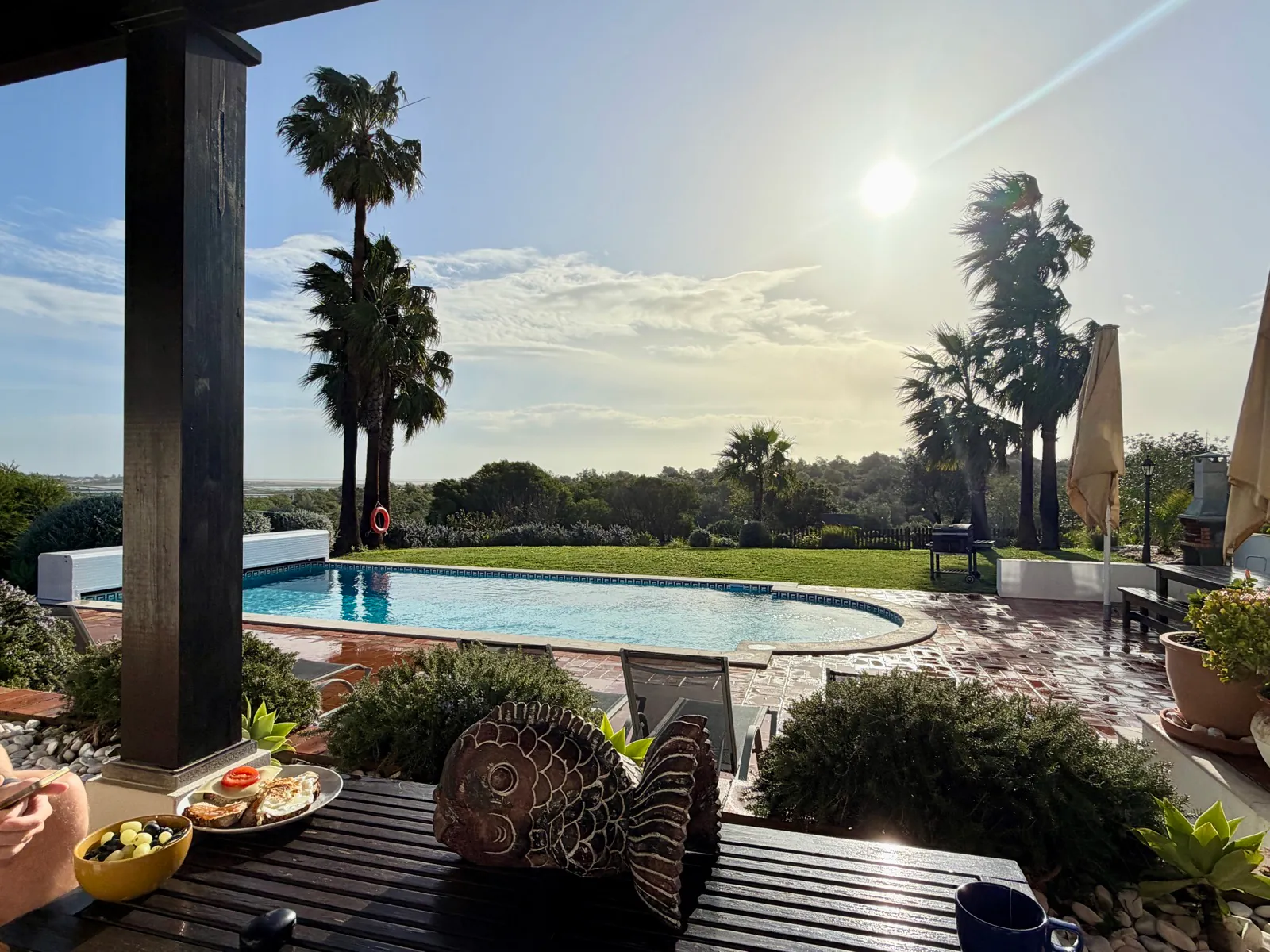
Pick a destination for two weeks and the food is entertainment. Pick one for two months and it is infrastructure — the thing that decides whether your Tuesday costs eight euros or thirty, and whether you cook at seven or give up and order.
On that measure the eastern Algarve in winter does better than its reputation, for an unglamorous reason. The restaurants that survive here in the cold half of the year are the ones serving people who live here. They are open because their customers never left.
The market is the load-bearing part
Olhão’s municipal market is two red-brick halls on the waterfront — fruit and vegetables in one, fish in the other — running six days a week and shutting around one in the afternoon, with a larger open-air market spreading into the street on Saturday mornings. It is among the biggest fresh-produce markets in the region [source: algarvetips.com] [source: visitolhao.pt].
Nothing about it is seasonal, because Olhão has more than 45,000 residents and is the Algarve’s largest fishing port [source: algarvetips.com] — the market exists to feed them, not you.
Across a thirteen-week winter stay based in Fuseta, the Saturday run to that market was the most reliable fixed point of the week: earlier than the social calendar, unaffected by weather that cancelled everything else, and the single largest reason a car never became necessary. Fuseta runs its own smaller farmers market for the mid-week top-up.
If you are comparing this region against somewhere with better beaches, weigh that. A month somewhere with a functioning market is materially cheaper and better fed than a month somewhere with a supermarket and four tourist restaurants.
The daily menu, which is the real find
The Portuguese lunch institution is the prato do dia — a set daily plate, often with soup or a starter, frequently a drink and a coffee, typically eight to thirteen euros [source: hotspotsalgarve.com].
In Fuseta the sharpest version of it is Delícias da taci, which does something better than a fixed menu: three options a day — meat, fish, vegetarian — rotated so completely that going every day never repeats itself. That is a genuinely different proposition from a restaurant with a menu you exhaust in a fortnight, and it is why it became the default lunch rather than an occasional one. One of the owners, Neil, will keep you company while you wait, on any subject you care to raise and several you don’t.
The economics of that are worth stating plainly. A daily menu lunch and a market-shopped dinner is a food budget that stops resembling travel and starts resembling life. Nobody is reimbursing your lunches — there is no per diem on a workation, whether you are on a payroll or invoicing for it — so the fact that the default option here is under ten euros is not a detail.
The rest of the short list
Fuseta’s full inventory takes one paragraph, which tells you the size of the place.
Casa Corvo for seafood — more expensive than the daily-menu places and the correct choice at least once, because claiming you ate well in the eastern Algarve without it is difficult to defend. Crispim for the unshowy version: nothing surprising, entirely solid, completely local. Fuzeta Tapas do Nik for the evening that isn’t a full dinner. O Coral for regional food at a fair price with occasional live music. Frango da Ria if what you want is chicken and no ceremony.
Breakfast is bakeries, or Madeira Madeira from seven in the morning if you want to be somewhere rather than at home.
And the drinking: Nanobrew, the village nanobrewery, which opens Friday to Sunday for around four hours and closes at nine. That is the whole nightlife of the town and, across a winter, one of the better rooms on this coast for actually meeting the people you keep passing in the street.
What this looks like across a month
The pattern that emerges is three-layered and hard to build anywhere with a resort economy.
Market shopping for most dinners, because the produce is good and close and the halls are open when you are not working. A daily-menu lunch out several times a week, because it costs less than the ingredients would and gets you out of the building. And a small handful of proper dinners a month at the places that deserve them.
A house with a kitchen makes that pattern work; a hotel room does not. It is one of the quieter arguments for a coliving over a rental here — POMAR na praia in Fuseta runs a weekly family dinner as part of the deal [source: pomar-coliving.com], and shared cooking turns a market run into a reasonable use of a Saturday rather than a chore for one.
Where it falls down
The inventory is genuinely short. A village of about 2,000 residents [source: algarvetips.com] supports perhaps six places you would return to, and by week six you know all of them. If variety is what makes eating out enjoyable for you, that is a real cost and it does not improve.
Sundays and Mondays thin out, and the closures are not always advertised — checking a door on the way past in the afternoon is more reliable than checking anything online.
There is very little international food. If you want Thai, or good Indian, or anything much beyond Portuguese with the occasional Brazilian crossover, you are cooking it yourself or going to Faro.
Who this region is right for, on food alone
People who cook, and want the raw material to be excellent and cheap. People who eat lunch out and dinner in. People who would rather have six good options they know than forty they don’t.
And not people who treat dinner as the evening’s entertainment. In winter, in a village here, dinner is at eight and the town is dark by ten — which is either the point of the whole trip or the reason to book somewhere else entirely.