POMAR Base: a good desk, and an Uber to everything else
The working half of this house is solid and the nights are the best thing in it. What costs you is the map: outside Olhão itself, nothing here happens without a car you don't have.
Community is what you make of it. Which is a problem if you don't make much.— On the half of the stay that refills you
POMAR Base: a good desk, and an Uber to everything else
A workation is two problems, and most places only solve one. The first is whether you can put in a real working day — not a laptop-on-a-terrace photograph, but nine to five with calls in it. The second is whether anything happens after you close the laptop that sends you back to it the next morning with something in the tank.
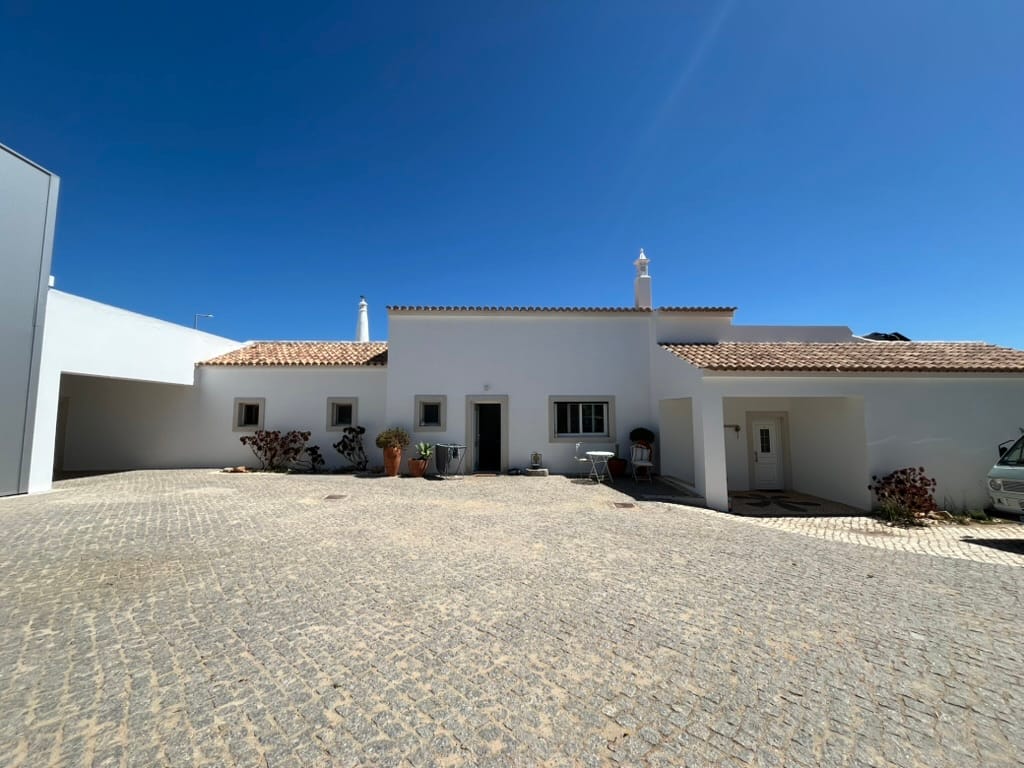
This is Pomar Coliving’s original place, a five-room farmhouse three kilometres short of Olhão [source: pomar-coliving.com], reopened as a beta test after a council put a road through the front garden. First stay in this house, second with the operator: I’d spent January to April at POMAR na praia, their place in Fuseta, so what follows is a comparison as much as a review. I booked four weeks, extended in week two, and stayed about nine.
The house solved the first problem, with a caveat about the heat. The second one cost me a great deal more than I expected, and most of what it cost arrived as fares.
Four desks, and the weather picks which
The room had a queen bed, its own bathroom, a working desk, a monitor and an ergonomic chair already in it. The sector’s default is a bedside table and an apology, so arriving to a setup rather than assembling one over three days is worth more than it sounds.
What I actually did was rotate. The terrace was the best desk in the house until it stopped being usable — by the end of June it was simply too hot to sit out there and work. After that the day ran indoors until noon, in the living area or the coworking room, then out to a small table in the front yard where there was shade, then into my own room for the late afternoon. Four working spots, chosen by temperature rather than by preference.
That rotation is the honest reason this scores an eight rather than a ten. The furniture is excellent; the usable hours in each spot are seasonal.
The other subtraction is other people. Some guests hadn’t worked out that taking a call in the communal area is a thing you inflict on everyone in it. In a five-room house that is not a scheduling problem, it’s a room-choice problem, and it sent me back to my own door more than once.
The line never gave me a reason to think about it. I never measured it, which is the weakest kind of endorsement and the only one I’m entitled to.
The nights are the best thing in the house
Quiet gets a ten, and I want to be precise about why, because the road outside would suggest otherwise.
A main street runs past the door, and partway through the stay the new highway next door opened to traffic. The house spent a few days braced for it. There is some road noise on the terrace — though by high summer nobody’s out there anyway — and at roof level you hear it without minding it. It never once reached my desk or a call. What does wake you is the neighbourhood’s dogs, reliably, in a way no passing motorbike manages. That’s the honest sound profile, and it is still the best sleep I’ve had in a coliving.
Everything except Olhão is a fare
Here is the bill, and it is structural rather than fixable.
Olhão itself is walkable: about thirty minutes on foot into the centre. Everything else is an Uber. The nearest beach, Praia dos Cavacos, is at least an hour walking; Praia da Armona is a fare plus a ferry, about an hour all in. For most of the stay nobody in the house had a car.
So Uber became the second-largest line in the month’s spending after the room, and I stopped noticing individual fares in a way that should probably have worried me. That is what a three-kilometre gap actually costs: not the distance, the ledger.
It compounds. When the supermarket is a decision rather than a walk, the spontaneous evening in town — the thing that empties your head after a bad afternoon — quietly stops happening. I usually lost that negotiation. And when you do get to the neighbourhood places where the food is genuinely good, bring cash: cards are fine in the bigger towns and often not an option in the back streets.
The community was there. I didn’t take it.
The house offers a community and I didn’t take it up. Worth being precise, because it reads like a complaint otherwise: the structure was all there — a video call before I’d arrived, everyone met on day one, a weekly meeting to rough out the week, avocado and orange picking on the farm next door, apricot cakes from that same farm, a self-catered family dinner. By week three I was running community workouts twice a week, in a fully equipped indoor gym the house already owned and nobody had organised anything around.
It just wasn’t my fit this time. Five rooms is a small gamble, and the smaller the house the bigger the gamble on chemistry. No villain in that sentence.
Where the energy actually came from
What refilled the tank was fifteen minutes up the road in Fuseta, where I’d just spent three months and still knew people. Nanobrew did most of the heavy lifting. Casa Corvo with the group beat the free dinner we’d been given at Cestaria — Bistro de Artesão in Olhão for a marketing video, which I suspect isn’t the intended outcome. Live music at O Farol that was far better than a spontaneous weeknight deserves.
And don’t forget the monthly neighborhood party at Amars Surf Academy near Faro.
In Olhão itself the short circuit was Café Tinto for coffee on the jogging round and Pizza na Pedra when cooking lost. Food at the house was self-catered on a base of what Pomar provides — eggs, bread, jam — so breakfast was mine, lunch was usually skipped or folded into an early dinner, and the rest was pizza or whatever came out of a community meal.
And the location I’d written off is the real recovery asset, once you can reach it. Being outside the centre makes the house a launch pad: cyclists and bikers start the ride instead of carving out of a town first, and hikers drive five or ten minutes in three directions out of four and land somewhere worth walking. It’s badly served by photographs and it’s the whole proposition. If you want a change of desk rather than a change of scene, A Fábrica de Olhão opened a coworking space in town that’s worth the trip.
Would I work from here again?
Around twelve hundred euros bought the first four weeks, with the breakfast basics included and everything else on top. At that price the room is good value and the fares are the part nobody quotes you.
The working half needs no fixing beyond an awning: desk, chair, monitor, line, gym, and nights that are genuinely excellent. The recovery half needs transport. Arrive with something flexible and the supermarket stops being an event, the launch-pad argument finally pays out, and the evenings in Fuseta are a decision rather than an expedition.
Would I go back? Kind of — but to Fuseta. That’s not a verdict on this house so much as on which of the two suits the way I actually live, and the fifteen kilometres between them are the whole of the difference.
Book it for the desk, the gym and the roads out. Don’t book it expecting three nights a week out until four — that was never what this house was selling, and the fifteen minutes to Fuseta are where you’d be going anyway.
Who it's for, this visit
- Deep-work stretches where a routine beats a roster of activities
- Light sleepers — the nights are the best thing about the house
- Anyone arriving with transport, or a budget to Uber without counting
Who'd be happier elsewhere
- Daily runners — the only route out is road
- Car-free travellers: everything except Olhão itself is a fare
- Beach-first travellers — the nearest sand is an hour on foot
Score breakdown
- Work setup
- 8.0
- Sleep / quiet
- 10.0
- Community fit
- 5.0
- Location
- 5.0
- Value
- 8.0