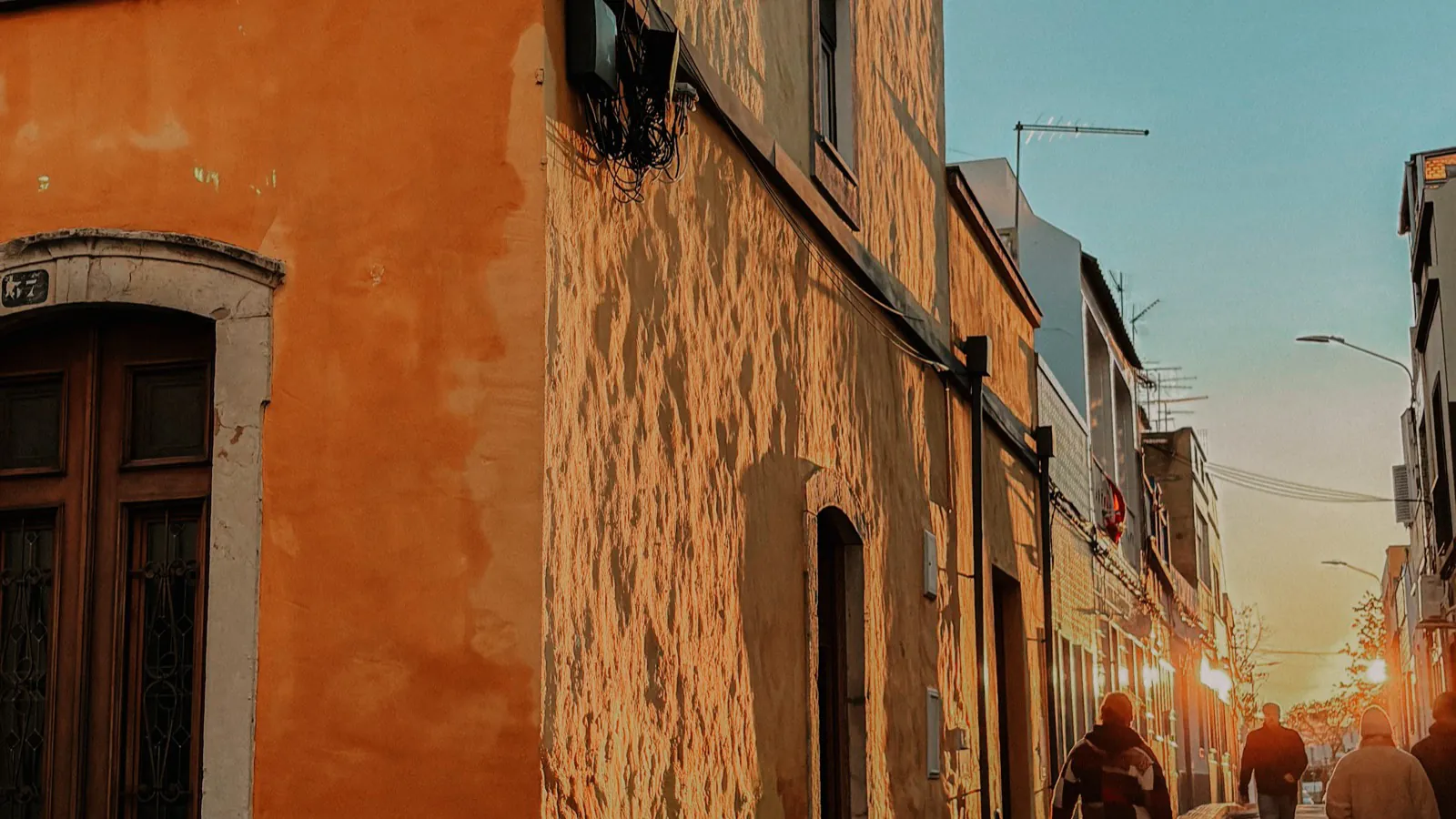
The interesting thing about working from a fishing village is that the village has already done half a day’s work by the time you open your laptop, and it does not care that you have a standup.
This is one Wednesday from the middle of my thirteen weeks at POMAR na praia — chosen precisely because nothing happened. No community meeting, no out-night in Faro, no weekend hike. The week’s shape is covered elsewhere. This is the day the shape is made of.
It fell in the first genuinely dry stretch of the stay, somewhere in late February: cool at seven and shirtsleeves by lunch, no rain at all that week, and enough breeze to notice but not enough to plan around. After the weeks that came before it, this counted as a heatwave.
Before anyone needs anything from you
The run goes out along the Ria at seven. Flat, hard-packed, salt pans on one side and the lagoon on the other, and — this is the part I did not expect — almost nobody on it. In three months the path was busy exactly twice.
Back at the house for weights in the garden. The gym is a kit rather than a room: kettlebells, dumbbells, TRX, bands and mats, used outdoors because there is nowhere else to use them. In February this is a genuine decision every morning rather than a lifestyle photograph.
Then the pool, which is heated only on request and for an extra fee, and which I was therefore using as a cold plunge. I would like to claim this was a considered protocol. It was a pricing structure.
Breakfast on the terrace, every day, without exception — the one constant that survived all thirteen weeks and every weather system the Atlantic sent.
The village is three hours ahead of you
Fuseta has about 2,000 permanent inhabitants [source: algarvetips.com], and a small harbour where the fishing boats sit in a row and are aggressively more photogenic than anything I did that day [source: algarvetips.com].
The house is in the village and about ten minutes from the sand [source: pomar-coliving.com], which means the walk into town is a walk, not a drive, and the village’s working day is something you pass through rather than observe.
By the time I was at a desk, the harbour had been going for hours. There is a specific and slightly humbling asymmetry to a place where the productive part of the day is finishing as yours begins. I never fully got over it. I also never once got up early enough to properly watch it, which tells you which of us was more committed.
The working block
The work happened in the coworking room — ergonomic chairs, 24-inch screens — and the honest note is that it could have happened almost anywhere in the house. Work weeks ran Monday to Friday, like they do everywhere.
The thing I had braced for was noise. There were people in the house on EU, UK and US-East hours, which on paper is a recipe for somebody taking a call at an hour that ruins somebody else’s focus. It never became a problem across the entire stay. Some of that is the building. Most of it is that a house of adults who all work for a living turns out to self-regulate without needing a rule about it.
Mid-stay I moved out of the quiet room and into the loudest one in the building, and it was better. That is its own story, but it is relevant here: on an ordinary Wednesday, the room you work from matters less than whether you can hear the house existing.
One thing worth planning before you arrive rather than discovering in week six: an ordinary weekday here is easy, and extending is not. On an employment contract that is a remote-work agreement with dates on it that somebody has to re-sign. Freelance, it is a question about whether your invoice pipeline tolerates another month away from wherever you usually sell from. Same deadline, different paperwork — and the week you want to extend is a bad week to start the conversation.
Lunch is the only fixed point
Delícias da taci does not have a menu. It has three options a day — meat, fish, vegetarian — and they change daily, which means you can eat there every day for a month without repeating yourself, and I came close to testing that claim properly.
Neil, one of the owners, will keep you company while you wait and will discuss any subject you put in front of him. This is either charming or a scheduling risk depending on how firm your afternoon is.
Somewhere in here is the actual argument for a village over a city: the decision cost of lunch is zero. There is no optimising to do. You go, you take whichever of the three you want, you come back.
What the village withholds
Here is the part nobody mentions. From the beach you can see the island across the water. The ferry across takes about ten minutes and costs €1.80 return — and it runs only from March until October [source: algarvetips.com].
The house season runs October to April. The two overlap badly on purpose: for most of a winter stay, the island is visible, close, and completely unreachable.
I found this genuinely clarifying. A working day in a summer beach town has a permanent low-grade argument running in the background about whether you should be at the beach. In February that argument does not exist, because the boat is not running and the answer is no. The town gives you the water as scenery and withholds it as an option, and my output was better for it.
Evening, and the four-hour window
Wednesday is the wrong day for the good bar. Nanobrew opens Friday to Sunday only, four hours a night, and shuts at nine. This is not a limitation so much as a filter — everyone who wants to be there is there, in the same four hours, which is why I never had a bad night in it.
So a Wednesday evening is the village’s ordinary offer: solid Portuguese food at Restaurante Crispim, tapas at Fuzeta Tapas do Nik, seafood at Restaurante Casa Corvo when the week has earned it. Or the house cooks and you eat with whoever is around.
Then it is quiet, early, and completely dark by the standards of anywhere with streetlights worth the name.
Would I do this again
Yes, and the unremarkable Wednesday is the reason. A stay like this gets sold on its weekends — the hikes, the markets, the night in Faro — and those were good. But you get about thirteen weekends and sixty-five weekdays, and if the weekdays do not work, nothing else rescues it.
What a small eastern Algarve town gives you on a weekday is a very short list of options and no argument about any of them. Run, work, eat the fish, work, walk back in the dark. The village is not performing for you. It is doing its own job, which it started before you woke up, and it will do it again tomorrow whether or not your sprint closes.