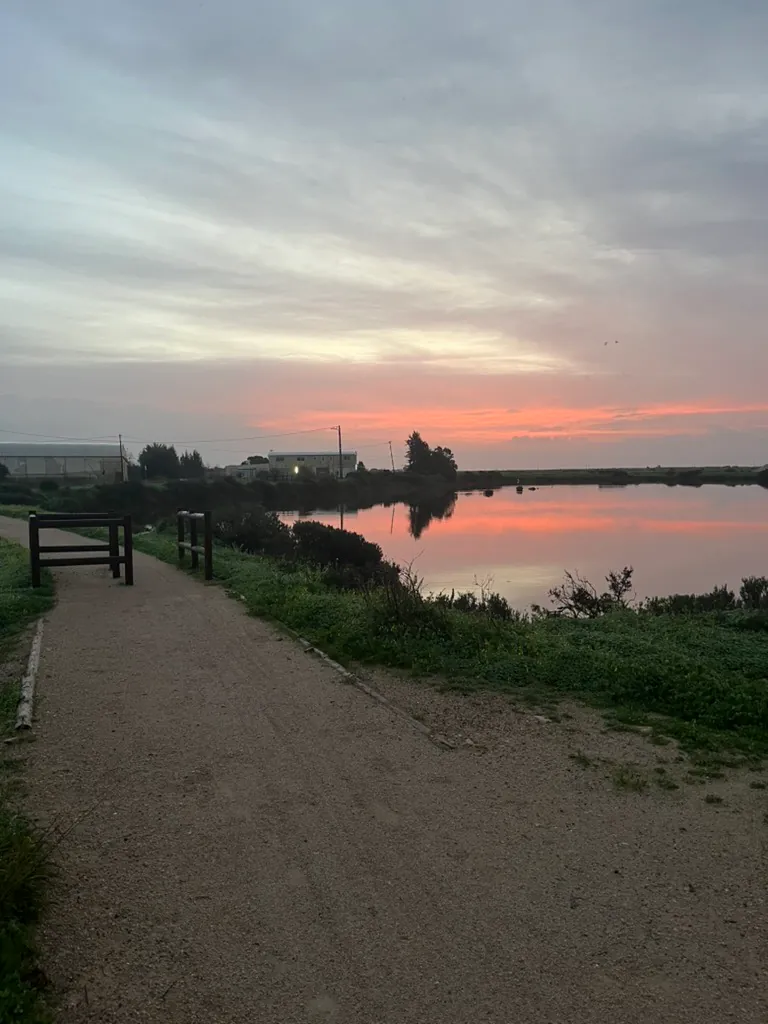
The run went out along the Ria at seven, most mornings, for thirteen weeks. Flat, hard-packed, salt pans on one side and the lagoon on the other. In three months the path was busy exactly twice.
That last sentence is the whole article, and the rest of it is the small print — because “empty at 7am” is true for two reasons, and only one of them is romantic.
The terrain
The Ria Formosa is a protected lagoon system and natural park covering roughly 18,000 hectares of channels, marsh, salt pans and barrier islands [source: lands.pt]. The running surface is the network of gravel and compacted-earth service tracks that run along the pans and the water’s edge, plus the occasional timber boardwalk where the marsh wins.
It is genuinely flat — not “gently rolling” flat, actually flat — which has two consequences. Your pace is honest, and there is nothing to break the wind. On a still morning that is the best easy-running surface I have had anywhere. On a bad one you are running into an unobstructed Atlantic headwind with nowhere to hide, and the return leg is a different sport from the outbound one.
From the house in Fuseta it starts immediately: POMAR na praia is in the village, about ten minutes’ walk from the sand [source: pomar-coliving.com], and the lagoon tracks begin where the village stops. No drive, no warm-up commute, which is most of why it happened daily rather than occasionally.
Seven in the morning is dark
Nobody mentions this in the winter-Algarve pitch. In January the sun comes up over this coast at around twenty to eight; by February it is a little after seven, and by March around half six [source: gaisma.com]. Then the clocks go forward at the end of March and it is dark again at seven for the last stretch of the season.
So for a large share of a winter stay, a seven o’clock start is a head-torch run on unlit tracks with no traffic, no lighting and no one to notice if you go over on a rut. That is not an argument against it — the tracks are wide, flat and free of obstacles, which is about as forgiving as night running gets — but it does mean the emptiness has a mundane explanation. Half the year you are out there alone because it is still night.
The compensation is that you finish as it gets light over the pans, which is a good deal even on the mornings you didn’t want it.
What is out there
Birds, mostly, and more than you would guess. The lagoon is a major wintering ground: over 20,000 birds across the season, with flamingos, spoonbills and avocets on the salt pans and large concentrations of waders on the mudflats [source: lands.pt]. Flamingos in the eastern Algarve are a winter claim that turns out to be true, which is unusual for a winter claim.
The tide changes what you are running beside rather than what you are running on. Around 90% of the lagoon’s area is intertidal [source: sciencedirect.com], so low water turns the view into mudflat and high water turns it back into a lagoon, with the bird life moving accordingly. The tracks along the pans stay dry through that cycle [verify: whether any lagoon-edge sections are cut off around spring high tides].
The weather is the only real obstacle
Not the terrain, not the darkness, not the surface. The wind and the rain.
Across a thirteen-week winter stay, the worst week rained on seven consecutive days. Two separate weeks brought wind that would have ended the run before it started, and a longer stretch paired a steady headwind with rain on five days out of seven. On an exposed lagoon track that is the difference between a routine and a decision you have to make again every morning.
The other side of the same season: the last stretch before the house closed ran dry for weeks at a time with light winds and lengthening evenings. The eastern Algarve does not deliver a consistent winter running climate. It delivers a good one and a genuinely hostile one, in blocks, and you find out which you booked when you get there.
Doing it alongside a job
The morning slot is not a preference here, it is arithmetic. In the depth of the season the sun is down by around half five in the afternoon [source: gaisma.com], which means anybody working European hours has no daylight left at the end of the day. Run before work or run in the dark; there is no third option until spring.
What made it stick was the chain rather than the run: out along the Ria at seven, weights in the garden afterwards on the house’s outdoor kit, then the pool as a cold plunge — heated only on request and for an extra fee, which is a pricing structure I chose to reframe as a protocol — then breakfast on the terrace, then work. Each step was already paid for by the one before it. Break the chain at the first link and the rest of the morning quietly doesn’t happen.
Two contract-shaped notes, because the slot is only free if your calendar agrees. On a payroll with European core hours the pre-work run is protected by definition; on US-East hours it is even easier, since your day starts in the afternoon. Freelance, the risk is the opposite one — nobody is stopping you moving the run to ten o’clock, and then to eleven, and then to nowhere.
Who this is wrong for
Hill runners, obviously. There is no elevation here and no prospect of any; the nearest gradient worth the name is inland and needs a car.
Also anyone who needs variety. This is the same flat, quiet, brown-and-silver landscape every morning, and the appeal is entirely that it asks nothing of you — no route decisions, no traffic, no company. If running is where you get your social contact, book somewhere with a parkrun. If running is where you get your first hour of the day back, this is close to the ideal version of it, for about half the year in the dark.