Burgas Coliving: a ten for the desk, a five for the map
The working half of this place is as good as I have had anywhere, and it cost about two hundred euros a week. The map is where you pay for it — in every evening that needs planning and every shop that needs a bus.
I gave the place two weeks to disappoint me. It needed a lot less than that to change my mind.— On arriving with an exit already booked
Burgas Coliving: a ten for the desk, a five for the map
The useful question about a place you work from is not whether you enjoyed it. It is what the stay produced, and whether anything reliably put back what the working day took out.
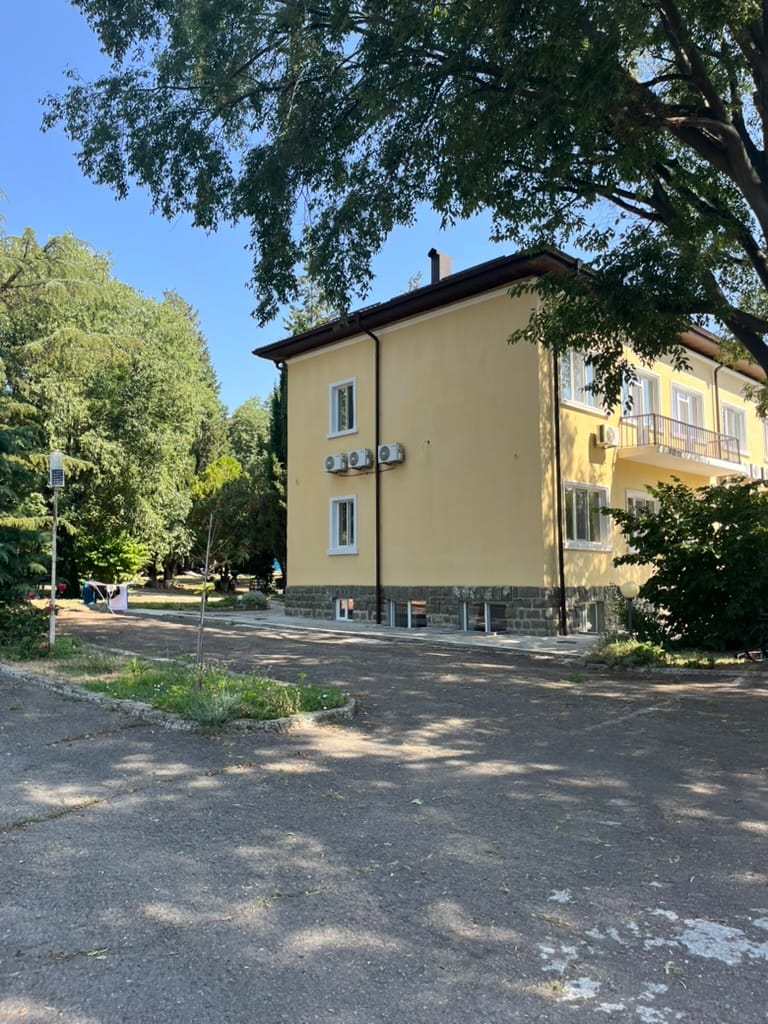
Burgas Coliving answered the first better than anywhere I have worked from, and it did it outdoors. The house is a former sanatorium in Vetren, fifteen kilometres inland from Burgas, built for people who came for the mineral springs. I arrived on a two-week trial with a way out already booked, because I was sceptical about who was running the community and had reasons that had nothing to do with the building. I left six weeks later.
The office is a garden table
I did almost none of my work in the coworking rooms.
The garden has a long community table and a few single tables beside it, and that is where the stay happened. The Wi-Fi covers the whole property — inside, outside, at the far tables — so where to sit was never a technical decision. That sounds minor until you have spent a month somewhere the signal ends at the terrace door.
Calls went from my room, which is the other half of a working setup and the half that gets forgotten. A house where you can work in company and then close a door for an hour is a house you can do a real job from. Nothing in six weeks made me think about the connection, and I should be honest about the limits of that: I never measured it. What I can tell you is that it never once decided where I sat or what I could take.
The only interruption came from working at the most sociable table in the building. People talk. That is not a fault of the house, it is a consequence of the chair I chose, and I chose it every day.
Two workouts and a working day
The shape that held for six weeks: workout, breakfast, work until noon, another workout, work until late afternoon, then over to whatever the house was doing.
Two training blocks inside a working day is not a rhythm most places allow you. This one does, because everything it needs is on site and none of it requires leaving, booking or good weather. I ran laps in the park next door. Everything else — bodyweight, kettlebell, yoga, pilates — happened on the outdoor deck in the garden. Work and training used the same garden four times a day, which is the most efficient thing about the place.
Sleep was the same story: nothing woke me, the whole stay. There is daytime noise, of course there is, it is a house full of people. The night is quiet.
Fifteen kilometres, one highway
Here is the cost, and it is structural rather than fixable.
One highway connects the house to Burgas. No footpath, no bike lane, nothing that works below traffic speed. The bus takes about twenty minutes, and the last one on a weekday goes around half eleven at night. Miss it and your options are a taxi or staying somewhere until morning — a real decision to be making at eleven, and one that shapes the evening from about eight onwards.
The same fifteen kilometres show up in the food. The supermarket nearest the house doesn’t carry enough range to eat well from, and eating in a balanced way was the one genuine daily challenge of the stay. Some local research turned up better options; the fallback was the bus into the city. Breakfast and lunch I made myself most days. Dinner was a snack, the brewery next door, or the house family dinner.
None of that is hardship. All of it is friction, and friction is what you are buying when you book fifteen kilometres out.
The community was excellent. The role was not.
Those are two different findings and they usually get blurred into one.
The person paid to run the community was barely present, didn’t show us the region, and didn’t bring the group together. That was the thing I had come braced for, and it arrived on schedule. It is also why the trial nearly ended the way I had planned.
What the house actually had was a very good community, which is not the same thing as good community management. One guest walked me down to Metalhead, the craft beer garden in the neighbourhood, and introduced me to the owners. Another, who arrived later and was properly curious about where she was, talked several of us out of the house and into the region for two days that changed the stay. The owner stepped into the community role herself, more than she had intended to that season, and brought more of the country and culture into the house than any programme had.
So the honest version is this: a paid role went undone, and unpaid people did it better. Whether that happens in your weeks depends on who else booked them — which no operator can promise and no review can hand over.
What put it back
The brewery next door did much of the work. Having Metalhead within walking distance of the door is dangerous in one specific way and excellent in every other: it was the default gathering point for some of the house all summer, and it closes early, so you go home at a sensible hour because the option to continue has been taken away from you.
Beyond that — two days out in the region, reached by bus into Burgas and taxi onward; the Sea Garden along the seafront; Barabar in the city, which had a band worth the trip most weekends; a Georgian feast in a residential street no tourist would find.
For the last weekend I rented an apartment in Burgas for three nights rather than commute the highway at night, and it became my favourite part of the stay. Which tells you something about the fifteen kilometres that nothing else here does.
The weather decided nothing. One or two wet days in six weeks; otherwise sunny, hot and humid.
What it costs, and whether I would do it again
About twelve hundred euros for the six weeks — bed, utilities, the coworking space and the workout area included. Meals are extra and individual; there is no house catering. Beer and the ingredients for community dinners sit on top of that and, in my case, were not a rounding error. The mineral pool and spa nearby are not part of the house, for the avoidance of doubt.
Two hundred euros a week for somewhere you can put in a full working day and two training sessions, on the coast, in summer, is why the value score is what it is. It was cheaper than being at home in Cologne.
Yes, I would go back, and it is already arranged — same season, with transport this time, which is the one change that matters.
One piece of advice, and it belongs on your first or second day rather than your last. Take the bus into the city and work out how the public transport actually functions. Buy your groceries at one of the Burgas markets, walk out to the pier, find a supermarket you like, and get to know the city on foot on the way there. Then take a yellow taxi back to the house, so you have learned how the taxis work before the night you need one.
Do that on day two, and the fifteen kilometres cost you a great deal less for the six weeks that follow.
Who it's for, this visit
- Deep-work stretches — the garden is a better office than most offices
- People who train daily and would rather do it on a deck than in a gym
- Anyone who wants a community rather than a programme
Who'd be happier elsewhere
- Beach-first travellers — the sea is a bus ride, not a walk
- Anyone who wants an unplanned hike in the afternoon
- Restricted or fussy eaters who won't want to shop in the city for it
Score breakdown
- Work setup
- 10.0
- Sleep / quiet
- 10.0
- Community fit
- 9.0
- Location
- 5.0
- Value
- 10.0